-
TTT


Demonstrating Competence Under The Building Safety Act: A Practical Guide For Building Services Contractors
Demonstrating Competence Under The Building Safety Act: A Practical Guide For Building Services Contractors
Non-members: £0.00
BESA Contractor: £0.00
Couldn't load pickup availability
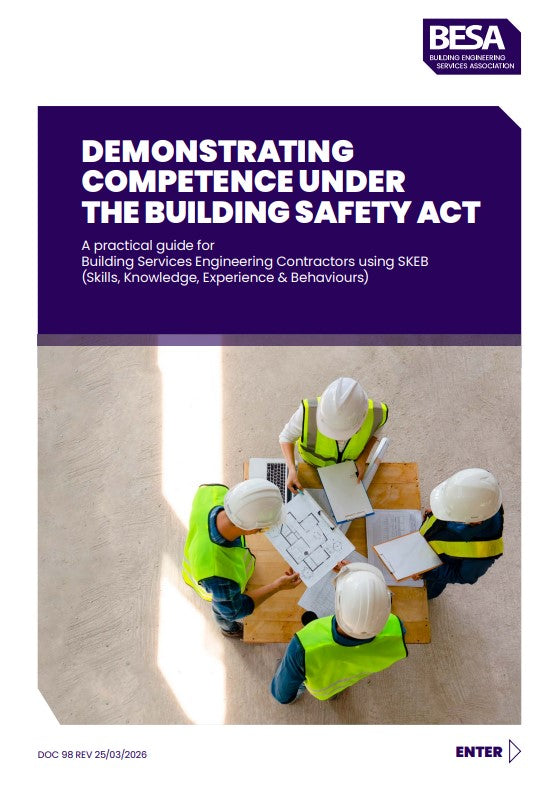
Demonstrating Competence Under the Building Safety Act is a practical guide for building services engineering contractors using the SKEB model – Skills, Knowledge, Experience and Behaviours – to assess, manage, and evidence workforce competence.
Developed by BESA, the guide provides a practical and proportionate approach for contractors that need to demonstrate competence, including in occupations where a formal NVQ, recognised qualification route, or fully developed competence framework may not yet exist.
Background
Competence is increasingly central to the way building services organisations manage people, allocate work, control risk, and demonstrate that individuals are capable of carrying out the tasks for which they are responsible.
Competence should not be treated as a one-off training or certification exercise. Organisations need an ongoing approach that allows them to understand the skills available within their workforce, identify gaps, review competence over time, and make decisions that are proportionate to the work and associated risks.
This guide has been developed to help building services engineering contractors put those principles into practice using a straightforward SKEB-based competence management approach.
What The Guide Covers
The guide explains how Skills, Knowledge, Experience and Behaviours can be considered together when assessing an individual’s competence. It provides a practical framework for recording evidence and supporting consistent decisions about whether people are competent to undertake particular activities.
It also helps organisations consider competence as part of their wider management and governance arrangements rather than relying solely on qualifications, training records, or certificates.
Using The SKEB Model
SKEB provides a structured way to consider the different elements that contribute to competence:
- Skills – the practical ability to carry out required tasks
- Knowledge – understanding of the work, relevant requirements, risks, and procedures
- Experience – relevant practical experience gained through carrying out comparable work
- Behaviours – the professional behaviours and attitudes needed to perform work responsibly and effectively
Considering these elements together can help contractors build a more complete picture of competence than relying on any single qualification or piece of evidence.
Who Should Use This Guide
This guide is intended for building services engineering contractors and other organisations responsible for managing, assessing, or demonstrating the competence of people carrying out building services work.
It will be particularly useful for business owners, directors, managers, supervisors, HR and training teams, compliance professionals, and those responsible for workforce development and competence management.
Key Topics Covered Include:
- Demonstrating competence within building services engineering
- Using Skills, Knowledge, Experience and Behaviours (SKEB)
- Assessing competence where formal frameworks are not available
- Allocating work based on demonstrable competence
- Recording and maintaining evidence of competence
- Monitoring and reviewing competence over time
- Identifying skills and competence gaps
- Supporting proportionate, risk-based competence decisions
- Integrating competence into organisational governance and management
A Practical Approach To Competence Management
The guide is designed to help contractors establish a simple and proportionate competence management system that can be applied in practice, including where occupational competence frameworks are still developing or fragmented.
It supports organisations in moving beyond a certificate-based view of competence towards an evidence-based approach that considers whether people have the appropriate combination of skills, knowledge, experience, and behaviours for the work they undertake.
Document Reference: DOC 98
Revision: 25/03/2026
Publisher: Building Engineering Services Association (BESA)
Free PDF Download